Why deeper work sometimes becomes necessary
In therapy and mental health conversations, coping skills are often presented as the primary solution to distress. Deep breathing, grounding exercises, journaling, meditation, exercise, and positive reframing are all valuable tools. They can reduce stress, regulate emotions, and help people move through difficult moments.
But there is a reality many people quietly experience: sometimes coping skills aren’t enough.
If you’ve ever tried every technique you know and still felt overwhelmed, anxious, or stuck, you’re not failing. You may simply be dealing with something that requires deeper psychological work.
The Purpose of Coping Skills
Coping skills are designed to help regulate the nervous system and manage distress in the moment. Techniques like breathing exercises activate the parasympathetic nervous system, which helps the body move out of fight-or-flight mode. Grounding techniques can bring attention back to the present moment when anxiety pulls the mind into worst-case scenarios.
These strategies are important. They create space between a trigger and a reaction.
However, coping skills primarily address the symptoms of distress, not always the underlying cause.
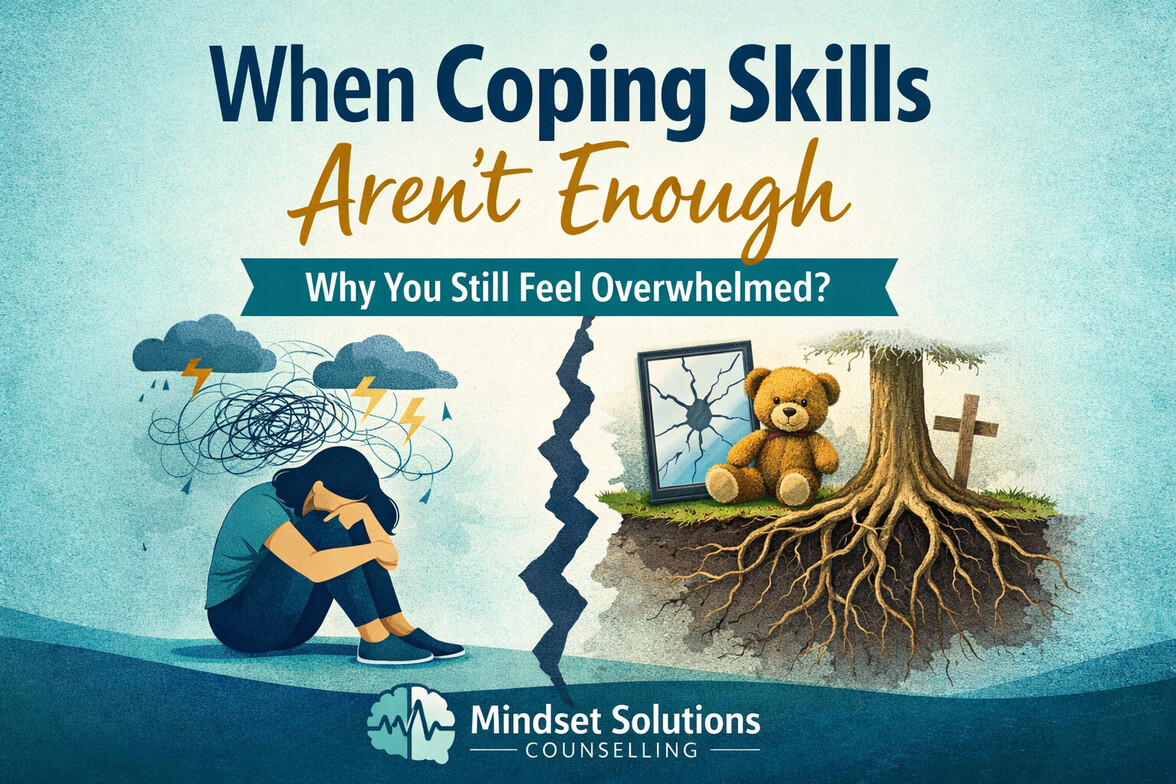
Imagine putting a bandage on a wound that keeps reopening. The bandage may protect it temporarily, but if something continues to irritate or reinjure the area, the healing process cannot fully happen.
When Coping Skills Stop Working
Many people become frustrated when coping strategies stop providing relief. They might think:
-
“Why isn’t this working anymore?”
-
“Everyone says this should help.”
-
“Maybe I’m just not trying hard enough.”
Often, the issue is not effort. The issue is depth.
When emotional distress is rooted in unresolved experiences, long-standing patterns, trauma, relationship dynamics, or deeply held beliefs about oneself, surface-level strategies can only go so far.
For example:
-
Anxiety may be connected to a long history of feeling responsible for other people’s emotions.
-
Chronic self-criticism might stem from early environments where mistakes were not safe.
-
Relationship conflicts may reflect attachment patterns developed years earlier.
No amount of breathing exercises alone can fully resolve those deeper layers.
The Role of Therapy Beyond Coping
Therapy can move beyond symptom management and begin exploring the patterns beneath the distress.
Approaches such as Acceptance and Commitment Therapy (ACT) help individuals understand how avoidance and struggle with internal experiences can keep anxiety cycles going. Internal Family Systems (IFS) explores different “parts” of the self that carry fear, shame, or protective strategies. Cognitive-behavioural approaches examine the beliefs that influence emotional reactions.
This deeper work is not about eliminating coping skills. Rather, it helps explain why certain situations trigger strong emotional responses in the first place.
Once the underlying processes become clearer, coping strategies often start working more effectively again because they are being applied within a broader understanding of the problem.
When to Consider Deeper Support
If you find yourself relying heavily on coping skills but still feeling stuck, it may be helpful to consider additional support. Signs that deeper work might be useful include:
-
Anxiety that returns quickly after using coping strategies
-
Repeating the same patterns in relationships or decision-making
-
Feeling emotionally overwhelmed despite knowing many coping techniques
-
Persistent self-criticism or shame
-
A sense that something deeper is driving your reactions
Seeking help in these moments is not a sign of weakness. It’s often the next step in understanding yourself more fully.
A Different Way to Think About Coping
Coping skills are tools. They are incredibly valuable tools. But tools alone don’t build the entire structure.
Sometimes the real work involves understanding the blueprint — the experiences, beliefs, and emotional patterns that shape how we respond to the world.
When that deeper understanding begins to form, coping skills become part of a larger process of growth rather than the only line of defence against distress.
If you’re feeling stuck despite trying many coping strategies, therapy can help explore what might be happening underneath the surface.
Learn more about counselling and support at:
www.mindsetsolutionscounselling.ca