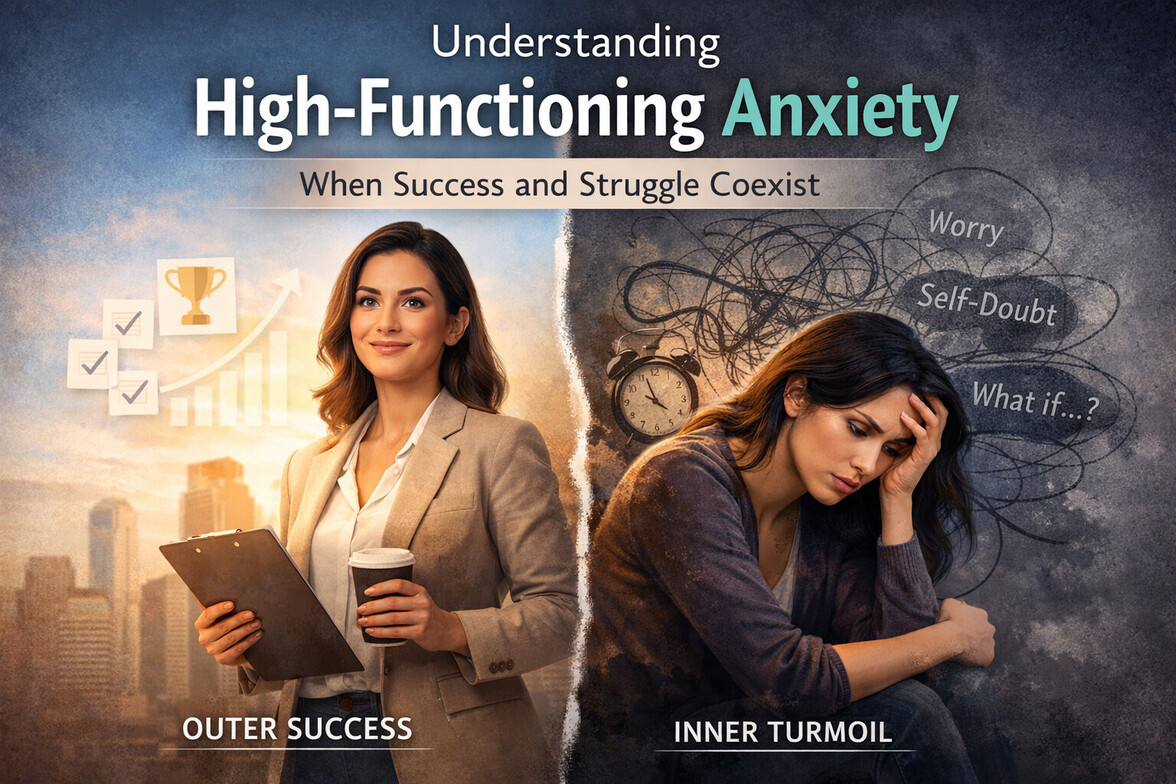
When success and struggle coexist
High-functioning anxiety doesn’t always look like anxiety.
In fact, from the outside, it often looks like success. Productivity. Reliability. Achievement. The person who has it all together.
But internally, the experience can feel very different.
What Is High-Functioning Anxiety?
High-functioning anxiety is not a formal diagnosis in the DSM-5, but it is a very real and commonly experienced pattern. It often overlaps with conditions such as Generalized Anxiety Disorder (GAD), but presents in a way that is masked by competence and performance.
People with high-functioning anxiety tend to:
-
Appear calm, organized, and successful
-
Meet deadlines and exceed expectations
-
Be highly dependable and driven
Yet internally, they may experience:
-
Persistent worry or “overthinking”
-
A constant sense of pressure or urgency
-
Fear of failure despite evidence of competence
-
Difficulty relaxing or “switching off”
-
Harsh self-criticism
There’s often a disconnect between how someone is perceived and how they actually feel.
Why It Often Goes Unnoticed
High-functioning anxiety is reinforced by external validation.
When someone is praised for being productive, responsible, or high-achieving, the anxiety driving those behaviours can be unintentionally rewarded. Over time, this creates a cycle:
Anxiety → Overperformance → Praise → Reinforced Anxiety
Because things are “getting done,” the internal cost is rarely questioned—by others or even by the person experiencing it.
Common Signs You Might Be Experiencing It
You might resonate with high-functioning anxiety if:
-
You feel guilty when resting
-
You struggle to say no, even when overwhelmed
-
You replay conversations or decisions repeatedly
-
You set very high standards and rarely feel satisfied
-
You rely on being busy to avoid uncomfortable thoughts
-
You appear confident, but internally doubt yourself
It’s not about whether you’re functioning—it’s about the cost of that functioning.
The Hidden Impact
Over time, high-functioning anxiety can lead to:
-
Emotional exhaustion or burnout
-
Sleep difficulties
-
Increased irritability
-
Strained relationships
-
Disconnection from your own needs and values
Many people don’t seek support until the system they’ve relied on—pushing through—stops working.
Why It’s So Hard to Let Go
High-functioning anxiety can feel useful.
It may sound like:
-
“If I stop worrying, I’ll fall behind.”
-
“This is just what keeps me motivated.”
-
“I can handle it—I always do.”
And in some ways, it has worked. That’s what makes it so difficult to shift.
But there’s a difference between motivation and pressure, between discipline and fear.
What Actually Helps
Addressing high-functioning anxiety isn’t about becoming less driven—it’s about changing the fuel source behind your behaviour.
Some evidence-based approaches include:
1. Awareness and Cognitive Defusion (ACT)
Learning to notice anxious thoughts without automatically believing or acting on them.
2. Values-Based Living
Shifting from fear-driven action to values-driven action:
-
“Am I doing this because I’m anxious, or because it matters to me?”
3. Self-Compassion Work
Reducing the intensity of the inner critic and building a more balanced internal dialogue.
4. Nervous System Regulation
Incorporating practices that signal safety to the body (e.g., slowing down, grounding, intentional rest).
5. Boundaries and Behavioural Experiments
Testing what happens when you say no, rest, or do “less than perfect.”
A Different Way Forward
You don’t have to earn rest.
You don’t have to prove your worth through constant output.
And you don’t have to keep carrying anxiety just because it’s been effective.
High-functioning anxiety often develops for understandable reasons—but it doesn’t have to be permanent.
Final Reflection
What would change if your life was guided less by pressure—and more by intention?
That question alone can be a powerful starting point.
If this resonates with you, therapy can help you unpack the patterns behind high-functioning anxiety and build a more sustainable, balanced way of living.
Learn more or book a session:
www.mindsetsolutionscounselling.ca