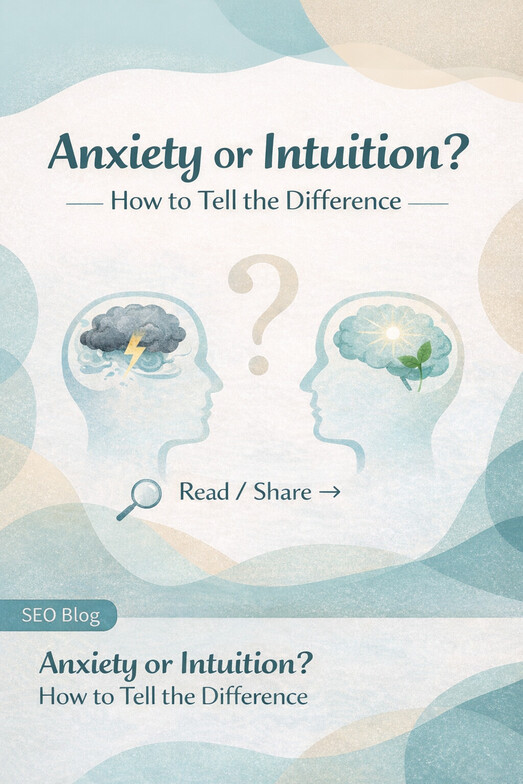
Is this my intuition… or is this my anxiety?
It’s one of the most common questions I hear in therapy. And it makes sense. Both anxiety and intuition can feel urgent. Both can feel protective. Both can show up quickly in the body.
But they are not the same thing.
Understanding the difference can change how you respond — in relationships, at work, and within yourself.
What Anxiety Feels Like
Anxiety is future-focused. It scans for threat. It asks, “What if something goes wrong?”
Physiologically, anxiety activates the nervous system — fight, flight, freeze. Your heart rate increases. Your chest tightens. Your thoughts speed up. The mind begins generating scenarios.
Anxiety tends to:
-
Feel loud, repetitive, and urgent
-
Spiral into multiple “what if” outcomes
-
Seek certainty and reassurance
-
Get stronger the more you engage with it
It often sounds like:
-
“What if they’re mad at me?”
-
“Did I say too much?”
-
“Something feels off — this is bad.”
-
“I need to fix this right now.”
Anxiety is protective. It’s trying to prevent pain. But it often overestimates danger and underestimates your ability to cope.
What Intuition Feels Like
Intuition is quieter.
It doesn’t spiral. It doesn’t argue. It doesn’t need to convince you.
Intuition tends to:
-
Feel calm but clear
-
Be specific rather than catastrophic
-
Repeat gently rather than shout
-
Exist without urgency
It often sounds like:
-
“This doesn’t feel aligned.”
-
“I need more information before I decide.”
-
“This boundary matters.”
-
“Something about this isn’t for me.”
Intuition doesn’t flood your system. It informs you.
The Nervous System Difference
One of the clearest distinctions is physiological regulation.
Anxiety = activated nervous system.
Intuition = regulated nervous system.
If your body feels flooded, shaky, panicked, or desperate for certainty, you’re likely in anxiety.
If your body feels steady — even if the message is uncomfortable — you’re more likely accessing intuition.
That doesn’t mean intuition feels pleasant. Sometimes intuition asks you to leave, speak up, or disappoint someone. But it won’t feel chaotic.
A Practical Test: Delay and Observe
If you’re unsure, pause.
Anxiety demands immediate action.
Intuition tolerates space.
Try this:
-
Take 24 hours (if possible).
-
Regulate your body first — breathe, move, ground.
-
Revisit the thought.
If the message escalates, multiplies, and becomes more catastrophic, that’s anxiety.
If the message remains steady and clear without intensifying, that may be intuition.
Why This Matters in Relationships
In dating and long-term partnerships, anxiety often masquerades as intuition.
Anxiety says:
-
“They didn’t text back. Something’s wrong.”
-
“I feel insecure — this must mean they’re not right for me.”
Intuition says:
-
“I consistently feel dismissed.”
-
“My needs aren’t being met here.”
Anxiety is about fear of abandonment.
Intuition is about alignment and values.
Learning the difference builds relational trust — not just trust in others, but trust in yourself.
The Goal Isn’t to Eliminate Anxiety
The goal isn’t to silence anxiety. It’s to recognize it.
When you can say, “This is anxiety talking,” you gain choice.
You can regulate first.
You can gather data.
You can respond instead of react.
And over time, as your nervous system becomes more regulated, intuition becomes easier to hear.
If you’re struggling to tell the difference between anxiety and intuition, you’re not broken. You’re human. And this is a skill that can be learned.
Therapy can help you strengthen that internal discernment — so your decisions come from clarity, not fear.
If this resonated, feel free to read and share.