Read time: 6–8 minutes
SEO Keywords: social comparison and mental health, effects of social media on self-esteem, anxiety and social media, comparison and depression, how to stop comparing yourselfIf you’ve ever felt “behind” after scrolling, questioned your relationship after seeing someone else’s highlight reel, or doubted your competence after reading a professional update — you are not weak.
You are participating in a deeply human psychological process: social comparison.
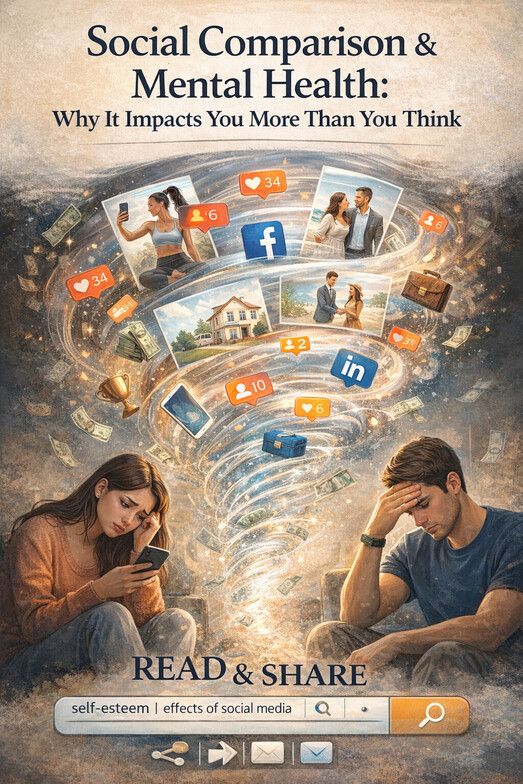
Understanding how social comparison operates — especially in the era of Instagram, Facebook, and LinkedIn — is essential for protecting your mental health.
Let’s break it down clinically.
What Is Social Comparison?
Social comparison theory was first proposed by psychologist Leon Festinger in 1954. His core premise: humans evaluate themselves by comparing themselves to others.
This process is automatic. It is not a flaw. It is adaptive.
We compare to:
-
Assess safety
-
Determine belonging
-
Gauge competence
-
Understand social hierarchy
-
Regulate self-concept
In small, stable communities, this mechanism had limits. In digital ecosystems, those limits no longer exist.
You are no longer comparing yourself to 30–50 people in your immediate environment.
You are comparing yourself to thousands.
The Two Types of Social Comparison
1. Upward Comparison
Comparing yourself to someone perceived as “better” in some domain.
Examples:
-
Someone’s engagement announcement
-
A colleague’s promotion
-
A curated family vacation
Upward comparison can inspire growth.
It can also trigger inadequacy, anxiety, and shame.
2. Downward Comparison
Comparing yourself to someone perceived as “worse off.”
This can temporarily boost self-esteem — but it often reinforces fragile confidence rather than stable self-worth.
Neither form is inherently pathological. The frequency and intensity matter.
Social Media Amplifies Comparison Loops
Platforms are not neutral environments.
They are built around:
-
Variable reinforcement schedules
-
Intermittent reward systems
-
Algorithmic amplification of emotionally activating content
Your nervous system does not differentiate between:
-
Physical social evaluation
-
Digital social evaluation
When you feel activated after scrolling, your brain interprets social discrepancy as potential threat.
This can manifest as:
-
Increased anxiety
-
Depressive rumination
-
Body dissatisfaction
-
Relationship insecurity
-
Career self-doubt
Research consistently links heavy social media use with increased symptoms of depression and anxiety — particularly when usage is passive and comparison-based.
Why Comparison Feels So Personal
Here’s the critical piece: comparison attacks identity.
It doesn’t just say:
“They are doing well.”
It implies:
“What does that say about me?”
When exposure is chronic, your internal narrative shifts from curiosity to self-critique.
And because platforms like LinkedIn amplify achievement and platforms like Instagram amplify aesthetic and relational perfection, the domains under attack are often the ones most tied to self-worth.
Career.
Relationships.
Appearance.
Lifestyle.
These are not superficial categories. They are identity anchors.
Signs Social Comparison Is Affecting Your Mental Health
You may notice:
-
Mood shifts immediately after scrolling
-
Rumination about someone else’s life
-
Increased urgency to “fix” yourself
-
Compulsive checking
-
Heightened relational insecurity
-
Loss of contentment in areas that previously felt stable
These are regulatory signals — not evidence of weakness.
How to Protect Your Mental Health Without Avoiding the World
The goal is not elimination.
The goal is intentional engagement.
1. Track Activation
Before and after scrolling, ask:
-
What emotion is present?
-
What story am I telling myself?
-
Is this data accurate or curated?
2. Reduce Passive Consumption
Passive scrolling increases comparison.
Active engagement (messaging, learning, connecting) reduces it.
3. Curate Your Environment
Mute accounts that consistently trigger insecurity.
Follow accounts that provide education, realism, or emotional grounding.
4. Strengthen Internal Metrics
Comparison weakens when identity is internally anchored.
Ask:
-
What actually matters to me?
-
What does success mean in my own value system?
-
Who was I before this app existed?
5. Regulate the Nervous System
If you feel activated:
-
Pause
-
Breathe slowly (longer exhale than inhale)
-
Physically move
-
Step outside
Physiological regulation precedes cognitive clarity.
The Deeper Work: Rebuilding Self-Trust
Comparison becomes toxic when self-worth is externally sourced.
Rebuilding self-trust involves:
-
Differentiating values from visibility
-
Separating curated reality from lived complexity
-
Recognizing that algorithms reward extremes, not balance
Mental health is not about becoming immune to comparison.
It is about:
-
Noticing it
-
Naming it
-
Responding intentionally
Final Thought
You are not weak for being affected by social media.
You are navigating an environment engineered for comparison.
The strength is not in pretending it doesn’t affect you.
The strength is in adjusting exposure, regulating your nervous system, and anchoring identity internally.
If this resonated, share it with someone who may need it — or reach out if you want to explore how social comparison is impacting your relationships, anxiety, or sense of self.
Psychological awareness is protective.
Intentionality is power.