Anxiety is uncomfortable.
Sometimes intensely so.
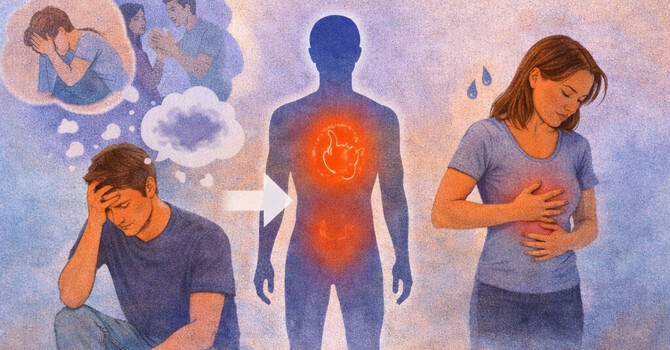
It brings racing thoughts, tightness in the chest, restlessness, mental looping, and a powerful urge to escape whatever feels threatening.
And that urge makes sense.
Avoidance works — at least in the short term.
If you cancel the plan, the anxiety drops.
If you avoid the difficult conversation, you feel immediate relief.
If you distract yourself from the intrusive thought, your nervous system settles.
Relief feels like success.
But here’s the paradox:
The very thing that reduces anxiety in the moment is often what keeps it alive long term.
This is the anxiety avoidance cycle — and understanding it is one of the most important steps in breaking free.
The Anxiety Avoidance Cycle
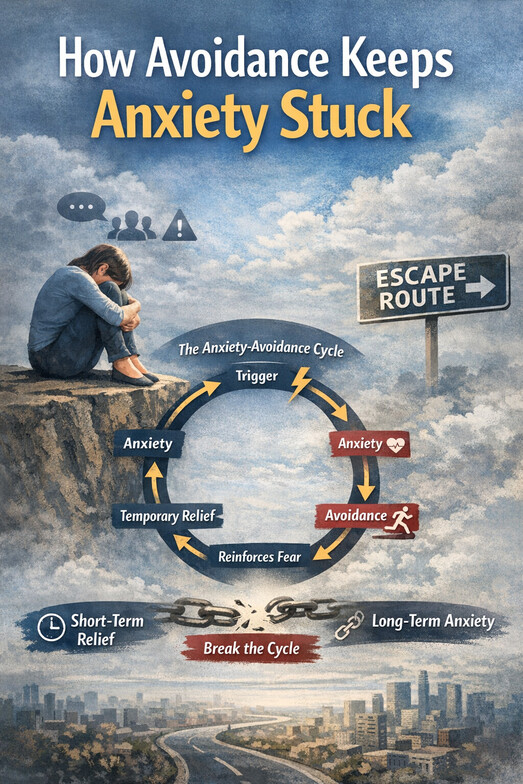
The anxiety avoidance cycle works like this:
-
Trigger – A situation, thought, memory, sensation, or uncertainty.
-
Anxiety Response – Your nervous system activates. Fear, tension, urgency.
-
Avoidance or Safety Behaviour – You escape, postpone, seek reassurance, distract, over-prepare, or mentally ruminate.
-
Temporary Relief – Anxiety decreases.
-
Reinforcement – Your brain learns: “Avoidance kept me safe.”
And the cycle strengthens.
The next time a similar trigger appears, your nervous system reacts faster and more intensely.
Over time, your world can become smaller:
-
Fewer social situations
-
Less spontaneity
-
More reassurance-seeking
-
Increased dependence on “safe” conditions
-
Greater fear of internal sensations
Avoidance doesn’t just reduce anxiety.
It trains your brain to fear more.
How Avoidance Maintains Anxiety
Many people believe anxiety persists because the world is dangerous.
More often, anxiety persists because the brain has never had the chance to learn that it can cope.
Avoidance blocks corrective learning.
When you avoid:
-
You never discover that discomfort peaks and falls naturally.
-
You never test whether your feared outcome would actually happen.
-
You never build evidence that you can tolerate uncertainty.
-
You never allow habituation or inhibitory learning to occur.
Instead, your nervous system remains convinced that escape was necessary.
From a behavioural perspective, avoidance is negatively reinforced.
The removal of anxiety (even temporarily) strengthens the avoidance behaviour.
From a cognitive perspective, avoidance prevents belief updating.
The catastrophic prediction remains unchallenged.
From a physiological perspective, avoidance maintains hypervigilance and sensitivity to threat cues.
In short: avoidance feels protective, but it maintains anxiety.
The Many Forms of Avoidance
When people think of avoidance, they imagine obvious behaviours — like refusing to fly or declining invitations.
But avoidance is often subtle.
It can look like:
-
Over-preparing so you never feel uncertain
-
Excessive reassurance-seeking from partners or friends
-
Mental rumination to “solve” hypothetical threats
-
Constant distraction (scrolling, busyness, productivity)
-
Leaving early “just in case”
-
Avoiding internal experiences like sadness, anger, or vulnerability
Even perfectionism can function as avoidance — an attempt to prevent criticism or rejection.
This is why the anxiety avoidance cycle can be difficult to spot.
It hides inside seemingly responsible or productive behaviours.
Exposure and Anxiety: What It Really Means
Exposure and anxiety are often misunderstood.
Exposure does not mean:
-
Flooding yourself with overwhelming fear
-
Ignoring your limits
-
“Pushing through” with brute force
-
Forcing yourself into trauma-level distress
In evidence-based anxiety therapy (including ACT and CBT), exposure means:
Gradually and intentionally approaching what you fear, without relying on avoidance or safety behaviours.
Exposure works because it allows three critical things to happen:
-
Habituation – Anxiety rises, peaks, and falls on its own.
-
Inhibitory Learning – The brain updates its threat prediction.
-
Self-Efficacy Development – You build confidence in your ability to cope.
Over time, your nervous system recalibrates.
Not because the world changed — but because your relationship to fear changed.
Breaking Avoidance Patterns
Breaking avoidance patterns requires nuance.
If you move too fast, you overwhelm the system.
If you move too slowly, avoidance remains intact.
Here are foundational steps we often use in anxiety therapy in Calgary:
1. Identify the Avoidance
Start by asking:
-
What am I actually avoiding?
-
What discomfort am I unwilling to feel?
-
What safety behaviours am I relying on?
Clarity precedes change.
2. Distinguish Danger from Discomfort
Anxiety often conflates discomfort with threat.
Discomfort is not danger.
Breaking avoidance patterns involves learning to tolerate:
-
Uncertainty
-
Embarrassment
-
Imperfection
-
Vulnerability
-
Internal sensations
The goal is not to eliminate anxiety.
The goal is to expand your tolerance window.
3. Gradual, Structured Exposure
Create a fear hierarchy:
-
Mildly uncomfortable situations
-
Moderately distressing scenarios
-
High-anxiety triggers
Begin with manageable steps.
Stay long enough for anxiety to rise and fall naturally.
Avoid reassurance during the exposure.
Notice what happens when you don’t escape.
Each repetition weakens the anxiety avoidance cycle.
4. Reduce Safety Behaviours
Sometimes progress stalls not because exposure isn’t happening — but because safety behaviours remain.
For example:
-
Attending a social event but constantly checking your phone
-
Driving on the highway but calling someone to calm you
-
Speaking up but over-explaining to prevent misinterpretation
These behaviours blunt learning.
Removing them — gradually — allows your brain to update.
5. Incorporate Acceptance (ACT Principles)
Avoidance is often an attempt to eliminate internal discomfort.
ACT (Acceptance and Commitment Therapy) shifts the focus:
Instead of asking,
“How do I get rid of anxiety?”
We ask,
“How do I move toward what matters, even if anxiety is present?”
Anxiety shrinks when it is no longer the central decision-maker.
Values-driven action disrupts avoidance in a sustainable way.
Why Anxiety Therapy Helps
Many people attempt to break avoidance patterns alone.
Some succeed. Many get stuck.
In anxiety therapy in Calgary, the work often involves:
-
Mapping the anxiety avoidance cycle in detail
-
Identifying subtle safety behaviours
-
Building graded exposure plans
-
Addressing underlying core beliefs
-
Strengthening emotion regulation capacity
-
Practicing tolerating internal discomfort safely
Therapy provides structure, accountability, and nervous system co-regulation.
Most importantly, it creates a space where anxiety can be experienced without being escaped.
That experience alone is corrective.
A Gentle Reframe
If you see yourself in this pattern, it does not mean you are weak.
Avoidance is adaptive.
It is your nervous system trying to protect you.
The problem is not that you avoid.
The problem is that avoidance has become your primary coping strategy.
Freedom is not found in eliminating anxiety.
Freedom is found in expanding your life despite it.
Each time you stay in the discomfort a little longer…
Each time you resist reassurance…
Each time you move toward a value instead of away from fear…
The cycle loosens.
Anxiety does not disappear overnight.
But it does become less powerful.
If you’re noticing that avoidance has quietly narrowed your world, therapy can help you gently widen it again.
You do not have to force yourself into overwhelm.
You do not have to do it alone.
Learn more about anxiety therapy in Calgary at:
www.mindsetsolutionscounselling.ca