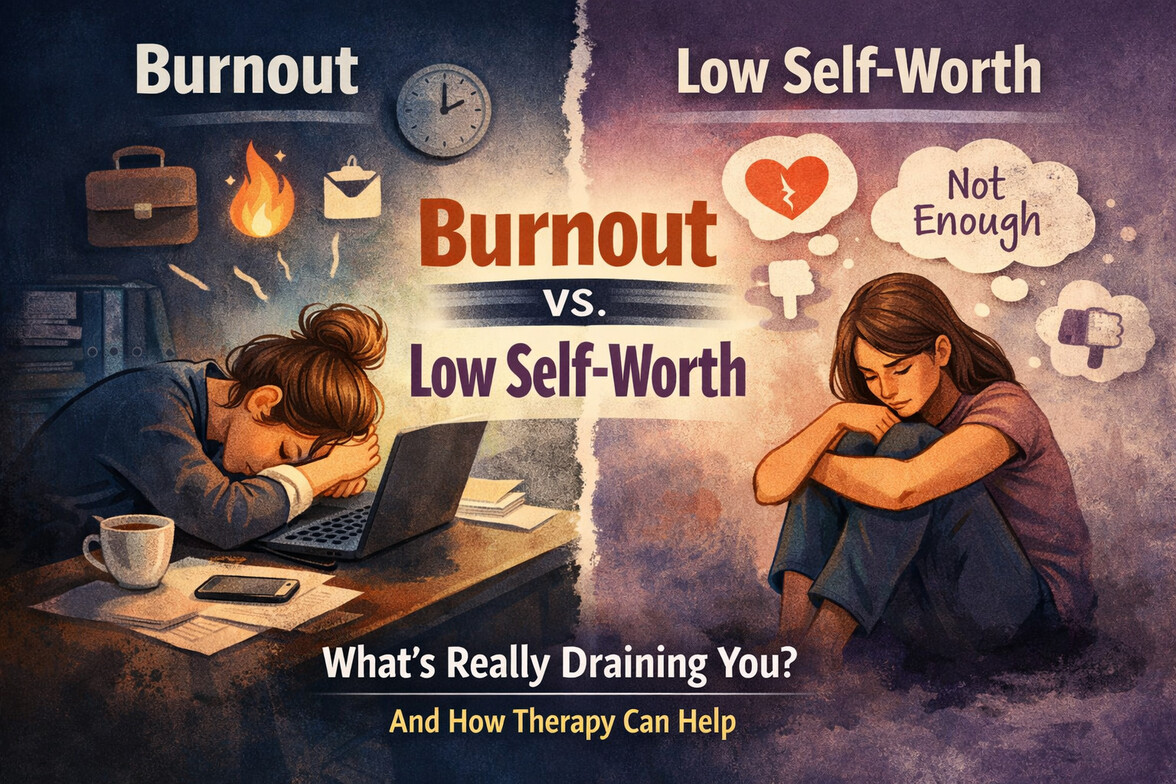
Burnout vs. Low Self-Worth: Why They’re Often Confused (and How Therapy Can Help)
Burnout and low self-worth are frequently used interchangeably — but clinically and psychologically, they are not the same thing. Many adults arrive in therapy believing they are “just burned out,” when the deeper issue is a long-standing pattern of self-criticism, over-responsibility, or conditional self-worth.
Understanding the difference matters, because the path to recovery looks very different for each.
What Burnout Actually Is
Burnout is a state-based response to chronic stress, most commonly linked to work, caregiving, or prolonged emotional demands.
Common signs of burnout include:
-
Emotional exhaustion and mental fatigue
-
Detachment or cynicism toward work or responsibilities
-
Reduced sense of effectiveness or accomplishment
-
Physical symptoms (sleep disruption, headaches, lowered immunity)
-
Feeling depleted rather than inadequate
Burnout typically improves when:
-
Stressors are reduced
-
Boundaries are strengthened
-
Rest, support, and recovery are prioritized
Importantly, burnout says “I’m overwhelmed” — not “I am the problem.”
What Low Self-Worth Looks Like
Low self-worth is not a temporary state. It is a core belief system that shapes how a person relates to themselves and others.
Signs of low self-worth often include:
-
Persistent self-criticism or harsh inner dialogue
-
Feeling “not enough” despite achievements
-
People-pleasing or difficulty saying no
-
Over-functioning and chronic responsibility-taking
-
Guilt when resting or prioritizing needs
-
Linking worth to productivity, approval, or performance
Unlike burnout, low self-worth does not resolve with rest alone. Even during time off, the internal pressure often remains.
Low self-worth says “I must earn rest, care, or belonging.”
Why Burnout and Low Self-Worth Overlap
The confusion happens because low self-worth often drives burnout.
People with fragile self-worth tend to:
-
Say yes too often
-
Push past limits
-
Ignore early signs of exhaustion
-
Tie identity to being reliable, strong, or needed
By the time burnout appears, the nervous system is already dysregulated — and the internal narrative is usually self-blaming:
“Why can’t I cope like everyone else?”
“What’s wrong with me?”
This is not a motivation problem. It’s a relationship-with-self problem.
A Key Differentiator: What Happens When You Rest?
A helpful clinical question is:
How do you feel when external demands are removed?
-
If rest brings relief and clarity → burnout is likely the primary issue
-
If rest triggers guilt, anxiety, or self-judgment → low self-worth is likely playing a significant role
Many adults experience both — but low self-worth often goes unaddressed, leading to repeated cycles of burnout.
How Therapy Helps Untangle the Two
In therapy, we don’t just aim to “reduce stress.” We explore:
-
Where self-worth became conditional
-
How early experiences shaped responsibility and approval-seeking
-
Why slowing down feels unsafe or undeserved
-
How internal standards were formed — and whose voice they belong to
Evidence-based approaches such as ACT (Acceptance and Commitment Therapy), Internal Family Systems (IFS), and CBT help clients:
-
Develop self-compassion without losing motivation
-
Set boundaries without guilt
-
Separate identity from productivity
-
Build worth that isn’t dependent on output or validation
This work is especially important for professionals, caregivers, high achievers, and those who have been “the strong one” for a long time.
You Don’t Have to Wait Until You’re Empty
You don’t need to be in crisis to start therapy.
And burnout doesn’t mean you’re weak — it often means you’ve been strong for too long without support.
If you’re noticing exhaustion and a harsh inner critic, therapy can help you address both — not just help you survive the next week.
If you’re looking for therapy in Calgary, I offer adult individual counselling focused on burnout, self-worth, anxiety, and relational patterns.
Learn more at: www.mindsetsolutionscounselling.ca