Emotional regulation is not about suppressing feelings or “staying positive.” It is the ability to notice, understand, and respond to emotions in ways that align with your values and long-term goals. When emotional regulation is underdeveloped, we see reactivity, withdrawal, rumination, or impulsive behaviour. When it is strengthened, we see steadiness, flexibility, and resilience.
In clinical psychology, emotional regulation is central to evidence-based approaches such as Acceptance and Commitment Therapy (ACT) and Cognitive Behavioral Therapy (CBT), both of which emphasize awareness, cognitive flexibility, and behaviour aligned with values rather than mood states.
Below are practical, research-informed emotional regulation skills you can begin using immediately.
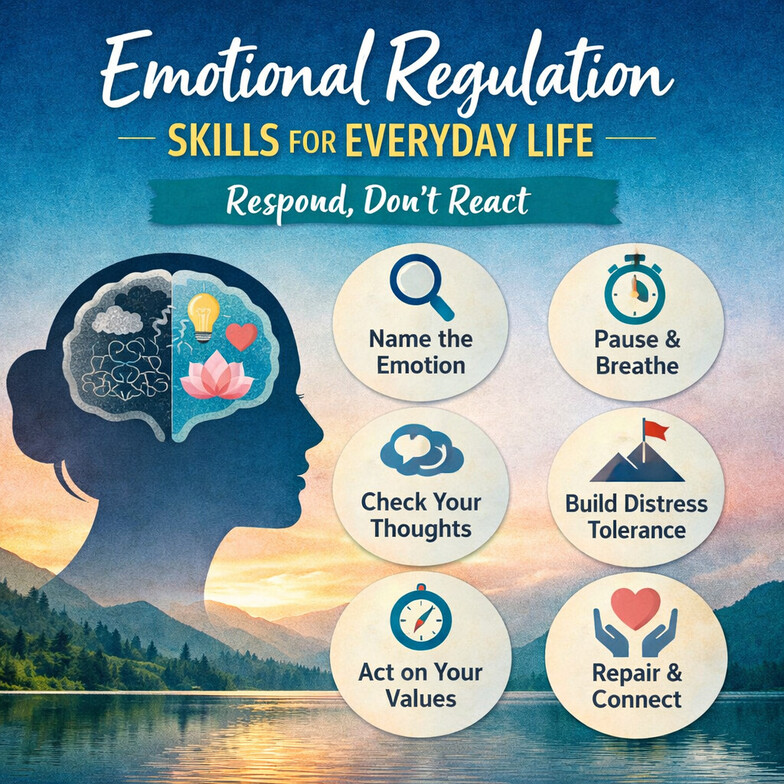
1. Name the Emotion Precisely
Research consistently shows that affect labeling reduces amygdala activation. In plain terms: when you name what you feel, your nervous system begins to settle.
Instead of saying:
-
“I’m stressed.”
Try:
-
“I’m overwhelmed and feeling inadequate.”
-
“I’m irritated and not feeling heard.”
-
“I’m anxious about uncertainty.”
Precision creates psychological distance.
Skill practice: Ask yourself, What exactly am I feeling right now? Use a feelings wheel if needed.
2. Pause the Nervous System
Emotional dysregulation is often physiological before it is cognitive. Your body shifts into sympathetic activation (fight-or-flight).
Regulation strategies:
-
Slow diaphragmatic breathing (4-second inhale, 6-second exhale)
-
Cold water on the face
-
A 5-minute brisk walk
-
Progressive muscle relaxation
You cannot think your way out of a fully activated nervous system. Regulate first. Reflect second.
3. Separate Thoughts from Facts
Emotions are often driven by interpretations rather than events.
Instead of:
-
“They ignored me because I don’t matter.”
Shift to:
-
“I’m having the thought that I don’t matter.”
This ACT-based cognitive defusion technique reduces over-identification with narratives and creates space for flexible responding.
4. Increase Distress Tolerance
Not all emotions need to be fixed. Some need to be endured.
Ask:
-
Can I allow this feeling to be here without immediately reacting?
-
What would it look like to sit with this discomfort for 90 seconds?
Emotions naturally rise, peak, and fall when not fueled by avoidance or escalation.
5. Align Behaviour with Values
Emotional regulation is not about feeling better; it is about functioning better.
If anger is present, the question becomes:
-
What action aligns with the kind of partner, parent, or professional I want to be?
Values-based action stabilizes identity, even when emotions fluctuate.
6. Repair Quickly After Reactivity
Dysregulation will happen. The goal is shorter duration and faster repair.
Effective repair includes:
-
Taking ownership without defensiveness
-
Naming impact
-
Clarifying needs
-
Re-engaging calmly
Relational resilience is built through repair, not perfection.
Why Emotional Regulation Matters
When emotional regulation improves:
-
Conflict becomes constructive rather than destructive
-
Anxiety becomes manageable rather than paralyzing
-
Parenting becomes intentional rather than reactive
-
Self-trust strengthens
Over time, consistent practice reshapes neural pathways. Regulation becomes more automatic, and emotional experiences feel less threatening.
When to Seek Support
If you find that emotions frequently feel overwhelming, lead to relational strain, or interfere with work and daily life, therapy can provide structured skill development. Evidence-based approaches like ACT and CBT offer measurable, practical tools for increasing emotional flexibility and resilience.
Emotional regulation is a skill set — not a personality trait. It can be developed at any stage of life.
Looking for support with emotional regulation in Calgary?
Learn more at www.mindsetsolutionscounselling.ca